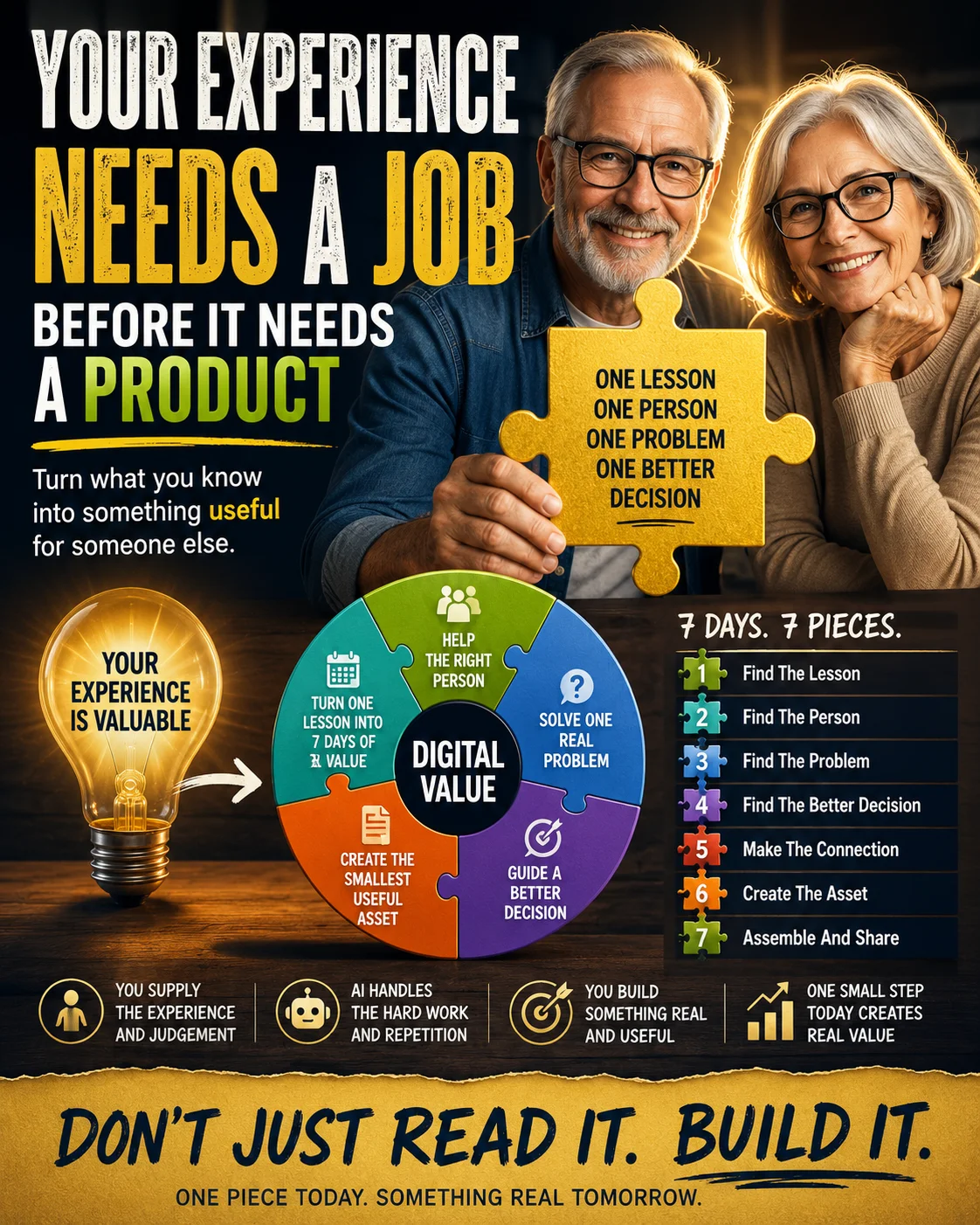
Test Your Useful Idea Before You Build The Wrong Thing
Test Your Useful Idea against a real moment of need before spending your time creating something nobody was actually waiting for.
Test Your Useful Idea Before The Workshop Gets Busy
A good idea can make you want to reach for the tools before you have worked out whether there is actually a job to do.
Test Your Useful Idea Against A Real Person
Yesterday gave your experience a job. Today we find out whether somebody would genuinely need that job doing.
Test Your Useful Idea At The Moment It Matters
Find the person, find the moment and find the better decision. Only then should we start deciding what to build.
A dangerous little moment happens in every workshop when enthusiasm gets ahead of the job. You have found an idea. It feels useful. You can already see the checklist, ebook, video or beautifully polished PDF sitting on the bench. Before long you are choosing a title, wondering about the cover and deciding whether twelve pages would look more substantial than six. It feels like progress because you’re making things. Yet the most important question is still sitting unanswered in the corner: who actually needs this, and when? Today we are going to answer that before we spend another minute building.
That matters particularly when your raw material is a lifetime of experience. After decades of working, raising families, fixing problems, learning hobbies, managing money, dealing with customers or simply getting through ordinary life, you can know an enormous amount without noticing it. Yesterday’s job was to uncover one useful piece and give it a purpose. Today’s job is different. We are going to Test Your Useful Idea against the moment when another person might actually reach for it. If we can’t clearly identify that moment, the idea isn’t ready for the workbench yet.
Don’t Start With The Product
 Imagine a retired heating engineer sitting down to turn forty years of experience into something useful online. He could fill a book. Boilers, radiators, pumps, controls, quotations, breakdowns, customers, good installations, bad installations and the peculiar noises a central-heating system makes at half past six on a freezing January morning.
There is no shortage of knowledge. The temptation would be to call the project something impressive like The Complete Home Heating Guide and start writing. The trouble is that very few householders wake up on Tuesday morning thinking, “What I really need today is a complete education in domestic heating.”
Now put the same knowledge into a different scene. A homeowner stands at the kitchen table with a quotation for several thousand pounds. The boiler has stopped working. One installer says replacement is essential. Another has suggested additional work. The technical language means very little to the customer, yet a decision has to be made. Suddenly forty years of experience has somewhere useful to stand. The retired engineer doesn’t need to teach that person everything he knows. He may need to help them recognise five sensible questions worth asking before accepting the quotation.
That is the distinction we are after today. A subject can be interesting. A moment of need makes it useful. “Central heating” is a subject. “I have been told my boiler needs replacing and I don’t know what to ask” is a moment. “Using AI” is a subject. “I have opened an AI assistant for the first time, and I haven’t a clue what to type” is a moment. “Starting online after retirement” is enormous. “I have forty years of experience but cannot see what part of it could help somebody else” is something we can actually work with.
Test Your Useful Idea By Finding The Moment
Here is where today’s Jigsaw piece begins to earn its place. Take the one-sentence job statement you created yesterday and resist the urge to improve it. Don’t add more knowledge. Don’t make it sound more professional. Instead, put an imaginary person in front of it. What has just happened to them? What are they looking at? What are they worried about getting wrong? What decision are they trying to make? If you can describe that scene in ordinary language, you are beginning to discover whether your experience has a genuine job rather than merely an interesting subject attached to it.
Think of someone who spent years running a small building business. “I know how to run a building business” contains plenty of experience, but it doesn’t tell us where that experience becomes valuable. Now picture a newly self-employed tradesman at the kitchen table on Sunday evening. A customer has asked for his first sizeable quotation. He knows roughly what the materials will cost, but he is worried about forgetting labour, waste, travelling time or some awkward part of the job. He isn’t searching for a business degree. He wants enough clarity to send a sensible quotation on Monday morning without discovering three weeks later that he has worked for next to nothing.
Our experienced builder can now see his useful idea differently. Perhaps the valuable lesson isn’t “how to run a successful building company.” It may be something much smaller: what to check before sending your first substantial quotation. That doesn’t make his forty years of experience smaller. It makes one part of it usable. This is one of the most useful habits we can develop during this 28-day journey. We are not trying to empty everything you know onto the internet. We are learning to recognise the particular moments when a small piece of what you know could make somebody else’s next step easier.
One Person, One Problem, One Better Decision
Keep this simple test beside you whenever an idea starts growing arms and legs: one person, one problem, one better decision. If you find yourself describing three different types of people, solving six problems and making an entire transformation, stop. The idea is becoming too large. Narrowing isn’t throwing knowledge away. It is choosing which piece of knowledge gets today’s job. The rest stays safely in the toolbox for another day. A plumber doesn’t empty every fitting in the van onto the customer’s floor before repairing one leaking pipe. Digital knowledge doesn’t need to behave differently.
So ask who needs this particular lesson. Then ask what is happening when they need it. Finally, ask what they could understand, avoid, decide or do better after receiving your help. We aren’t looking for dramatic promises. The improvement can be wonderfully ordinary. They ask better questions before agreeing to work. They know which three things belong on their first homepage. They can write their first sensible instruction to an AI assistant. They recognise what to check before buying a tool. They leave the lesson with one decision that feels clearer than it did ten minutes earlier. That is useful value.
Useful Experience Often Looks Ordinary From Your Side
This is where years of experience can play a trick on you. The things you learned the hard way eventually become so familiar that you stop seeing them as knowledge. You look at a quotation and immediately notice what is missing. You hear a customer describe a problem and know which question to ask next. You open a piece of software and instinctively know where to look. Someone standing at the beginning cannot borrow those instincts unless you turn them back into something visible. What feels obvious from your end of forty years may still be completely unfamiliar from their end of five minutes.
That means today’s test isn’t asking, “Is my idea clever enough?” It is asking something much more useful: does this lesson arrive at a moment when another person would be glad to have it? If the answer is yes, we have something worth carrying forward. If the answer is fuzzy, that’s useful information too. We narrow the person, sharpen the problem or look again at the moment. Five minutes spent discovering that an idea is too broad can save hours creating something impressive that nobody knows why they should use.
Don’t Choose The Container Yet
One final temptation to resist today. Once the useful moment turns clear, your brain will immediately want to decide what to make. Checklist? PDF? Article? Video? Worksheet? Mini-course? Leave the shelves empty for another day. The format is not the value. The help is the value. A one-page sheet arriving at exactly the right moment can outperform fifty pages arriving without a clear reason. First prove the person, the problem and the better decision. Once those are clear, choosing the smallest useful container becomes much easier.
For today, bring yesterday’s answer forward and put it through three questions. Who needs it? When do they need it? What could they decide or do better afterwards? Then complete one sentence: “When this person reaches this situation, my experience can help them make this better decision.” Don’t polish it for Facebook. Don’t worry about keywords. Don’t try to sell it. We are still at the workbench testing the fit. If that sentence makes immediate sense to another ordinary person, today’s Jigsaw piece has done its job.
Tomorrow we can begin asking a very different question. Once we know somebody genuinely needs help, what is the smallest useful thing we could build to give them?
Test Your Useful Idea Against A Real-Life Situation
There is a simple way to make today’s test harder to fool. Stop describing the idea in general terms and put it inside a real-life scene. Imagine the person standing in the exact place where your experience might help them. What are they looking at? What has just happened? What are they afraid of getting wrong? What would they type into Google, ask a friend, or mutter to themselves over a cup of tea? The more clearly you can picture that moment, the easier it becomes to Test Your Useful Idea without flattering yourself into believing that every interesting thought deserves to become a product.
Suppose somebody spent years helping older relatives with smartphones. They know how to enlarge text, move photographs, switch off annoying notifications, recognise suspicious messages and recover when something seems to disappear. “Smartphone help for older people” sounds useful, but it is still broad enough to become a bloated guide. Now picture one seventy-year-old opening a new phone on Christmas morning, seeing fifty unfamiliar icons and being frightened to press the wrong thing. Suddenly the useful job becomes clearer. What they need first is not a phone course. They need enough reassurance to make three safe first moves.
Test Your Useful Idea With A Better-Afterwards Sentence
Once the moment is visible, ask one more question: what should be easier afterwards? This is where vague ideas either sharpen or collapse. Finish the sentence, “After using this, the person should be better able to…” If the answer is something foggy like “understand technology better” or “be more confident online,” keep narrowing it down. Better answers sound like, “send their first photograph without worrying they have deleted it,” or “ask three sensible questions before accepting a quotation.” The improvement does not have to be dramatic. In fact, modest outcomes are often more believable, more useful and easier to turn into a small digital asset later.
This better-afterwards sentence is useful because it prevents us from confusing information with progress. You can give someone a great deal of information and still leave them standing in the same place. A ten-page explanation about online safety might be technically useful, yet if the reader still cannot decide whether one particular message looks suspicious, the information has not done its job. On the other hand, one simple decision sheet that helps them pause, check the sender, inspect the link and decide whether to delete the message may create a much clearer result. The quantity of information is not the measure. The better the decision is.
One Problem Stops A Good Idea Becoming A Monster
Ideas tend to grow when you leave them alone. You begin with one helpful lesson and, within half an hour, it has developed chapters, bonuses, videos, templates and a vague ambition to solve the entire internet. That is usually not because the first idea was poor. It is because experience contains too many connected lessons. The cure is not to abandon the idea. The cure is to give it a smaller job. One person. One problem. One decision. Those three boundaries can turn a wide subject into something a beginner might actually finish and another person might actually use.
Take somebody who spent years organising family finances. They know about bills, household records, bank statements, renewals, insurance paperwork and keeping track of what is due.
The broad idea might become “organise your finances after retirement.” That could swallow a month of work before breakfast. A narrower situation might be a recently retired couple who have suddenly got pensions, savings accounts, utility renewals and paperwork in several drawers and cannot remember where anything is. One problem could be: what information should we gather into one place before we need it? That is a job small enough to test and potentially useful enough to build.
Familiar Knowledge Can Hide In Plain Sight
One of the oddest things about experience is that the best material regularly feels too ordinary to mention. You learned something twenty years ago, repeated it hundreds of times and eventually stopped thinking about it. A beginner sees none of that history. They only see the moment when they don’t know what to do. That is why retirees can sometimes underestimate the value of what sits inside routine knowledge. The lesson does not have to be rare. It has to be useful at the point where somebody else has not learned it yet. Familiarity to you is not proof that the lesson has no value.
Remember this when you Test Your Useful Idea. Do not reject a lesson simply because it seems obvious. Instead, ask whether it would have been obvious to you before you had the experience. A retired shopkeeper may instinctively know when a customer is confused rather than uninterested. A former office manager may know how to organise a messy handover. A grandparent who has spent years booking holidays online may know which details to collect before comparing prices. None of those skills sounds glamorous. Yet each can become useful when attached to the right person, moment and decision.
Test Your Useful Idea Before Choosing The Format
Now comes another useful bit of discipline. Even when today’s idea passes the test, do not rush to decide whether it should become an ebook, checklist, worksheet, article, prompt or video. That choice belongs to the problem, not to our enthusiasm. If someone needs a quick reminder while standing in a shop, a one-page checklist may beat a twenty-minute video. If the problem requires explanation, an article may be better. If the person needs to think through their own situation, a worksheet or AI prompt may do more work than a static guide. The container comes after the useful job becomes clear.
This is where many first-time creators accidentally make their own life harder. They choose the format they fancy creating rather than the format the other person needs. Someone likes writing, so everything becomes an ebook. Someone discovers video, so every lesson needs filming. Someone has bought design software, so suddenly every idea requires a polished PDF. The better rule is almost boringly simple: prove the need first, then choose the smallest container that can do the job. That approach protects your time, reduces unfinished projects and gives you a much better chance of creating something another person can use quickly.
Your Useful Idea Should Survive Three Questions
By now, yesterday’s one-sentence job statement should be getting sharper rather than longer. Put it through three questions once more. Who needs it? When do they need it? What can they do better afterwards? If any answer still sounds vague, narrow the idea again. “Retirees who want help online” is too broad. “A retiree opening an AI assistant for the first time who does not know what to type” is clearer. “They will understand AI” is vague. “They will be able to write their first useful instruction and recognise whether the answer helped” gives us something we can actually build around.
And notice what has happened across these first two Jigsaw pieces. Yesterday we did not ask you to invent a business. We asked you to find one useful job inside your experience. Today we did not ask you to make a product. We tested whether that job belongs to a real person at a real moment. That may feel slower than charging straight into creation, but it is actually the shorter road. We remove expensive mistakes before they happen. A bad idea discovered on paper costs minutes. A bad idea discovered after weeks of building costs considerably more.
Apprentice Task: Test Today’s Jigsaw Piece
Bring forward the one-sentence job statement you created yesterday. Write down one recognisable person who might need it. Describe the exact situation where that person would reach for help. Then complete the sentence: “After using this, the person should be better able to…” Keep narrowing until the answer describes one modest, useful improvement. Finally, rewrite your job statement as: “When this person reaches this situation, my experience can help them make this better decision.” If that sentence is clear enough for another ordinary person to understand immediately, today’s piece is ready to keep.
Your Apprentice Task gives you today’s job. The printable Jigsaw Worksheet below helps you actually complete it. Fill in today’s piece, keep your answers, and bring them forward because tomorrow’s lesson will build directly on what you write today.
Open to See This Video, And This Is What’s Already Built,
Trained & Waiting For Your First Command.
Tomorrow’s Piece: Build The Smallest Useful Asset
Tomorrow we finally get to move closer to making something. But even then, we won’t build a giant course, stuff fifty pages into an ebook, or disappear into design software for a week. We will take the person, moment and better decision you have tested today and ask one practical question: what is the smallest useful digital asset that could perform this job well? By then, the format will have somewhere sensible to come from. Today proves the need. Tomorrow gives that need a shape.

Take Today’s Jigsaw Conversation To Facebook
Today’s lesson is simple: before you build anything, prove that somebody actually needs the help.
So here’s today’s question:
What is one lesson from your own working life or experience that somebody else might need at a very specific moment?
Maybe it helps them avoid a mistake, ask a better question, make a clearer decision or simply know what to do next.
Come and join the conversation with the AI Personal Assistance Crew on Facebook. Tell us the lesson and the moment when you think somebody would need it.
One person. One problem. One better decision.